Understanding amphibian disease inside out

1024px-AD2009Sep15_Rana_temporaria_01

A Common Frog (Rana temporaria) – Photo by Bernie Kohl


In the spring of 2010, I was doing amphibian surveys among a few wetlands in Eastern Kentucky that were known for their excellent diversity. As I sauntered up to a familiar study site, I was greeted with an amphibian massacre. Hundreds of dead tadpoles floated on the surface of the wetland, creating a raft of amphibian biomass unlike anything I’d ever seen.
I was stunned. What happened? Continue reading

Posted in RNAseq, transcriptomics | Tagged , , | Leave a comment

Gene expression analysis- are we doing it wrong?


In the last few weeks, three new preprints have come out suggesting that like Jack Butler dropping his kids off at school in the movie Mr. Mom, when it comes to differential gene expression analyses, we’re doing it wrong. Continue reading

Posted in Uncategorized | 4 Comments

The Kennewick, and the Oase I

Last week was glorious for ancient DNA enthusiasts – here are some quick blurbs on findings from genomic analyses of the Kennewick man, and the Oase I individual.

Facial reconstructions of the Oase I individual (L), and the Kennewick man (R). Image courtesies: The Smithsonian Magazine  (http://thumbs.media.smithsonianmag.com//filer/51/9f/519fea8a-a215-48fe-ba09-fae09a0bb3e3/kennewick-hero.jpg__800x600_q85_crop.jpg), Dons Maps (http://donsmaps.com/romaniancaveskull.html)

Facial reconstructions of the Oase I individual (L), and the Kennewick man (R). Image courtesies: The Smithsonian Magazine (http://thumbs.media.smithsonianmag.com//filer/51/9f/519fea8a-a215-48fe-ba09-fae09a0bb3e3/kennewick-hero.jpg__800x600_q85_crop.jpg), Dons Maps (http://donsmaps.com/romaniancaveskull.html)


The ancestry and affiliations of Kennewick Man, Rasmussen et al. (2015) Nature DOI: 10.1038/nature14625
There has been much ado over the ancestry of the Kennewick Man – carbon-dating studies have dated his remains to ~8,500 ybp, morphological studies maintain distinction from Native American (Pacific Northwestern) ancestry, and teams of scientists and tribes battle on over the impending fate of the remains. Rasmussen et al. (2015) in an interesting turn of events, analyze genomic ancestry of the Kennewick man, and find clear evidence of Native American ancestry using both a PCA, and f3-statistics. Important findings of this study include: (a) rejection of Ainu/Polynesian ancestry of the Kennewick man, as suggested by morphological studies, (b) similarity in admixture proportions to Native American, particularly among claimant tribes, and (c) direct or derivative ancestry of current Native Americans from the Kennewick man. While this answers some questions about the ancestry of the Kennewick man, it also brings forth unaddressed details of ancestral admixture, and migration in Holocene Americas.

Identifying which modern Native American groups are most closely related to Kennewick Man is not possible at this time, since our comparative DNA database of modern people is limited, particularly for Native American groups in the United States.

An early modern human from Romania with a recent Neanderthal ancestor, Fu et al. (2015) Nature DOI: 10.1038/nature14558
Meanwhile, in a much more distant past, the Kennewick man’s ancestors were still diversifying out of Africa, admixing with Neanderthals around 37,000-86,000 ybp, with little knowledge of the process of admixture, or understanding of Neanderthal extinction. Fu et al. (2015) analyze ancient genomic DNA from the Oase I individual, one of the oldest modern human remains yet discovered to report 6.0% -9.4%  Neanderthal ancestry. In comparison with the Ust’-Ishim, Kostenki, and modern Chinese and European individuals, the Oase I individual contains 2-4 fold higher Neanderthal alleles. Analysis of IBD segment lengths (i.e. identical segments, unbroken by recombination) also indicates that the Neanderthal admixture occurred within 4-6 generations ancestral to the Oase I individual.

However, the absence of a clear relationship of the Oase 1 individual to later modern humans in Europe suggests that he may have been a member of an initial early modern human population that interbred with Neanderthals but did not contribute much to later European populations

References:
Rasmussen, Morten, et al. “The ancestry and affiliations of Kennewick Man.”Nature (2015). DOI: 10.1038/nature14625
Fu, Qiaomei, et al. “An early modern human from Romania with a recent Neanderthal ancestor.” Nature (2015). DOI: 10.1038/nature14558

Posted in evolution, genomics, Paleogenomics, population genetics | Tagged , , , , | Leave a comment

IBE/IBD Contour plots in R

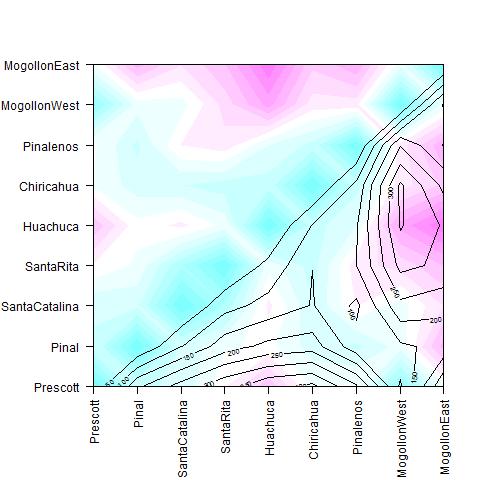
Rob’s post from yesterday motivated me to find an alternate way of visualizing correlations between matrices of geographical or ecological data, and genetic data. I have seen plenty of Mantel, or partial Mantel tests of correlation, as well as plots of “IBD”, or Isolation By Distance (which plots some genetic distance versus some ecological/geographical distance), but how fun would it be if you could visualize these correlations between sampling locales in different variables (here genetic differentiation, genetic distances, geographical distances, ecological distances, etc) on the same plot? So that’s exactly what I set out to do.

Contour plot of correlated geographical (black) and ecological distances (heat map), from Manthey and Moyle (2015).

Contour plot of correlated geographical (black) and ecological distances (heat map), from Manthey and Moyle (2015).


As an example, I downloaded the data from Table 2 of Manthey and Moyle (2015), which shows geographical distances versus ‘ecological’ distances. As a second example, I also downloaded data from Table 2 of Sethuraman et al. (2014), which shows population pairwise differentiation (Fst), versus geographical distances. I constructed symmetric matrices from these, and used the modified “filled.contour2” function (modified version of filled.contour) for these plots.
So, assuming that you have symmetric matrices saved as text files (you can download these examples from this link),

#Function courtesy http://tinyurl.com/oqxt8dq
matrix.axes <- function(data) {
x <- (1:dim(data)[1] - 1) / (dim(data)[1] - 1);
axis(side=1, at=x, labels=rownames(data), las=2);
x <- (1:dim(data)[2] - 1) / (dim(data)[2] - 1);
axis(side=2, at=x, labels=colnames(data), las=2);
}
source(“http://tinyurl.com/psdtkgr”)
n1<-as.matrix(read.table(“nuthatches-1”,row.names=1,header=TRUE))
n2<-as.matrix(read.table(“nuthatches-2”,row.names=1,header=TRUE))
par(mar=c(6,6,4,2)+0.5)
filled.contour2(n1,plot.axes=matrix.axes(n1))
contour(n2,col="black",add=T)

Contour plot of geographical distance (black) versus genetic differentiation (heat map) from the data of Sethuraman et al. (2013).

Contour plot of geographical distance (black) versus genetic differentiation (heat map) from the data of Sethuraman et al. (2013).


And voila! I modified the code above with different color palettes for the data of Sethuraman et al. (2013).
I find these plots a lot more informative than say Figure 3 of Manthey and Moyle (2015), or Figure 2 of Sethuraman et al. (2013). What are your thoughts? Do let me know! Ideally, I’d like to have this contour plot over a geographical map – but I’ll save that for a future post. Good luck!

Posted in bioinformatics, howto, population genetics, R, software | Tagged , , , | 5 Comments

Adapting to the new wave of isolation by environment

Image by Steve Ryan


Isolation by environment, not distance, explains the genetic relationship between an avian taxon among Madrean Sky Islands, according to a new study appearing in Molecular Ecology by Manthey and Moyle.
The authors throw the kitchen sink of new analyses at a combination of geographic, ecological, and genomic data and provide an interesting example of isolation by environment in a widespread species within a strongly heterogeneous landscape.
Figure 1 from Manthey and Moyle (2015) displaying the sampling areas of the Madrean Sky Islands

Figure 1 from Manthey and Moyle (2015) displaying the sampling areas of the Madrean Sky Islands


This new paper is significant in a couple ways. First, this is one of the first investigations of isolation by environment that utilizes hundreds of SNP loci, opening the door for the detection of adaptive loci that may relate to environmental distances. Second, the geographic scope of this taxon is unique since you may not expect a highly mobile bird to show such variation across a relatively small geographic scale.
If you are out there looking for a blueprint for the future of IBE studies, Manthey and Moyle have kindly provided a preview of the type of papers you are going to be reading quite often over the next few years.
Manthey, J. D., & Moyle, R. G. (2015). Isolation by environment in White‐breasted Nuthatches (Sitta carolinensis) of the Madrean Archipelago sky islands: a landscape genomics approach. Molecular ecology. DOI: 10.1111/mec.13258

Posted in adaptation, Molecular Ecology, the journal, phylogeography | Tagged , , | 1 Comment

The evolution of phylogeography in the next gen era: 20 years in review

Phylogeographers have long known about the limitations of single locus studies (ie, the effects of selective sweeps, stochasticity in lineage sorting among loci) and that adding loci improves the accuracy of demographic parameter estimates. As we continue to shift towards collecting multi-locus datasets thanks to high throughput sequencing, some interesting questions have come up. For example, what is the best ratio of genetic loci to individuals sampled? What is the role of mitochondrial (mtDNA) and chloroplast (cpDNA) loci in the next gen era? And most broadly, how has the field of phylogeography itself evolved in the last 20 years since the advent of high throughput sequencing?
Garrick et al. (2015) tackled these questions by exploring how phylogeography datasets have changed in the last 20 years. The authors collected empirical papers published in Molecular Ecology from 1992 to 2013 that had the search term term “phylogeograp*” in the title, abstract, keywords, or main text, sampling at 3 year intervals. The search resulted in over 1,200 hits. From these papers, the authors recored the following metrics:

  • total number of independent loci sampled (complete mtDNA or cpDNA genomes were treated as a single haploid locus)
  • total number of alleles sampled (identical alleles contributed to the count- this gave an idea of the number of individuals sampled per study)
  • total length in base pairs of DNA sequences collected
  • total number of SNPs identified
  • number of species surveyed (ie were data collected from a single species or was it a multi-species comparative study?)

The final dataset analyzed by Garrick et al. contained 508 single-species datasets drawn from 370 papers.

Fig. 2 Linear regression of a weighted metric (number of loci 9 total number of alleles sampled, log-transformed) as a function of time, partitioned by major taxonomic group. (a) vertebrates (N = 272 data sets). (b) invertebrates (N = 153). (c) plants (N = 52). (d) fungi, protists, algae and bacteria combined (i.e. ‘other,’ N = 16)

Figure and caption from Garrick et al 2015. Linear regression of a weighted metric (number of loci x total number of alleles sampled, log-transformed) as a function of time, partitioned by major taxonomic group. (a) vertebrates (N = 272 data sets). (b) invertebrates (N = 153). (c) plants (N = 52). (d) fungi, protists, algae and bacteria combined (i.e. ‘other,’ N = 16)


An increase in the size of phylogeographic datasets was found across most major taxonomic groups (see figure above) in terms of the number of loci and the number of alleles sampled, suggesting researchers are putting more effort into collecting genomic and geographic samples.
The use of mtDNA and cpDNA loci has declined in the last two decades, but few datasets contained autosomal loci only. As pointed out by Garrick et al., organellar markers are still useful for questions about sex-biased dispersal, directional introgression, and molecular rate estimation and therefore, “are unlikely to become obsolete, but rather will continue to represent an important part of the phylogeography toolbox.”
Using exploratory forecast modeling, Garrick et al. predicted that the number of SNPs per data set is likely to reach ~20,000 by the end of 2016 (95% CI 16,590 – 23,133) which represents more than a doubling over the preceding 3 year period (see figure below).
Forward-time projection of the total number of single nucleotide polymorphisms (SNPs) per published phylogeo- graphic data set, through to the end of the year 2016. Forecasts were generated using autoregressive integrated moving aver- age (median values in black, 95% confidence intervals in pale grey), conditioned on survey data spanning 1992–2013, sam- pled at 3-year intervals. For each year, only the five highest values for the total number of SNPs are shown

Figure and caption from Garrick et al. 2015 Forward-time projection of the total number of single nucleotide polymorphisms (SNPs) per published phylogeo- graphic data set, through to the end of the year 2016. Forecasts were generated using autoregressive integrated moving aver- age (median values in black, 95% confidence intervals in pale grey), conditioned on survey data spanning 1992–2013, sam- pled at 3-year intervals. For each year, only the five highest values for the total number of SNPs are shown


An interesting conclusion from the survey is the author’s claim about the field of landscape genetics, a topic that my fellow TME contributor Rob Denton wrote about last week (Landscape genetics gets existential). According to Garrick et al.:

…in the era of next-generation sequencing, the perceived distinction between landscape genetics and phylogeography (e.g. Wang 2010) increasingly represents a false dichotomy, as the resulting large DNA sequence data sets should be informative over a broad temporal spectrum. Indeed, the timescales on which inferences can be made are likely to depend more on geographic sampling of individuals than on choices relating to genetic data (Robinson et al. 2014a).

Another interesting finding of Garrick et al.’s analyses is that the number of individuals sampled has increased along with the increase in the number of loci being collected. Is this because we are obsessed with the idea that more data are always better? Or because the savings we accumulate as the cost of sequencing goes down are being spent adding more individuals to the experimental design? I wrote a few weeks ago that adding replicates trumps increasing sequencing depth in testing for differential gene expression but what is the optimum ratio of loci to individuals sampled now that phylogeographic studies are on pace to collect 20,000 SNPs per dataset? It feels a bit like blasphemy to write this but perhaps we can afford to scale back the number of individuals we sample per population and instead devote our time and money to collecting from additional geographic locations or to other projects entirely. Now that Garrick et al. have summarized how far the field has come in the last 20 years, I am excited to see where phylogeography goes next.
Reference
Garrick, R. C., Bonatelli, I. A., Hyseni, C., Morales, A., Pelletier, T. A., Perez, M. F., … & Carstens, B. C. (2015). The evolution of phylogeographic data sets. Molecular Ecology, 24 (6), 1164-1171. DOI: 10.1111/mec.13108

 

Posted in evolution, genomics, Molecular Ecology, the journal, next generation sequencing, phylogeography, Uncategorized | 3 Comments

Genomic history of Eurasia

The route of modern humans out of Africa has been contentious, with archaeological and genetic finds pointing towards a route through Egypt, versus one through Ethiopia. Pagani et al. (2015) analyze the genomic admixture of individuals sampled from both Egypt and Ethiopia in the context of the 1000 Genome Project dataset to get at this question, hypothesizing that individuals from either location would be closer “related” to Eurasians. Key findings of this study include (a) 80% of non-African ancestry in Egyptians, dated to ~750 ybp, coinciding with the Islamic expansion, (b) varying levels (up to 50%) non-African ancestry in Ethiopians, with admixture dating back to 2,500-3,000 ybp, (c) more predominant Egyptian haplotypes in CHB (Han Chinese) and Toscani Italian (TSI) samples, pointing to a northern route (via Egypt), contributing to greater levels of ancestry outside of Africa.

These findings point to the northern route as the preferential direction taken out of Africa. In doing this, they resolve the puzzles of archaeological similarities and Neandertal admixture, which are readily accommodated by a northern-exit model, but not by a southern exit, and fit well with the recent discovery of human remains dating to around 55,000 years ago in Israel (close to the northern route)

Neolithic sculptures from the Yamnaya culture.

Neolithic sculptures from the Yamnaya culture.


Continuing the story from above, as modern humans migrated out of Africa via Egypt into Eurasia, much less is known about the migratory epochs of the Bronze Age (3000-1000 BC). Alltentoft et al. (2015) sequence whole genomes of 101 Eurasian archaeological samples, and analyze population genomic history using admixture statistics.
Findings of Allentoft et al. (2015) depicting routes of migration of the Yamnaya culture into Europe and Asia. Image courtesy: Figure 1 of Alltentoft et al. (2015).

Findings of Allentoft et al. (2015) depicting routes of migration of the Yamnaya culture into Europe and Asia. Image courtesy: Figure 1 of Alltentoft et al. (2015).


Findings from this study include (a) Caucasian admixture early on into hunter-gatherers and Neolithic farmers in north-central Europe, coinciding with the expansion of the Yamnaya into Europe (b) a tandem Yamnaya expansion eastward into Asia, (c) fixation of light skin pigmentation SNP’s in Europeans during the Bronze Age, and (d) low frequencies of lactose tolerance alleles despite high tolerance in present-day Europeans.
 

We show that the Bronze Age was a highly dynamic period involving large-scale population migrations and replacements, responsible for shaping major parts of present-day demographic structure in both Europe and Asia.

References:
Allentoft ME. et al. (2015) Population genomics of Bronze Age Eurasia. Nature, June 2015. DOI: http://dx.doi.org/10.1038/nature14507
Pagani L. et al. (2015) Tracing the Route of Modern Humans out of Africa by Using 225 Human Genome Sequences from Ethiopians and Egyptians. AJHG Volume 96, Issue 6, p986-991. DOI: http://dx.doi.org/10.1016/j.ajhg.2015.04.019

Posted in genomics, Paleogenomics, population genetics | Tagged , , , , | Leave a comment

Landscape genetics gets existential

is-everything-even-anything
I had a lot of ideas for future posts, but “landscape genetics” keeps pulling me back.
Beyond the new methodology, reviews, and empirical findings, I suppose someone has to pump the brakes and get more existential. Rodney Dyer does just that in the upcoming Molecular Ecology opinion “Is there such a thing as landscape genetics?“, first seen on bioRxiv and Haldane’s Sieve.
Continue reading

Posted in Molecular Ecology views, Molecular Ecology, the journal, population genetics | Tagged , | 1 Comment

Old dogs, and 'carnivorous' pandas

It was a good fortnight for large mammals! Two recent studies attempt to date the emergence of modern canids, and offer insights into the gut microbiomes of giant pandas.

In retrospect, Po could quite possibly kick butt, and chomp on the Wolf Boss just as well…(Image courtesy: Kung Fu Panda 2)


Ancient Wolf Genome Reveals an Early Divergence of Domestic Dog Ancestors and Admixture into High-Latitude Breeds. Skoglund et al. (2015) Current Biology
Previous studies have dated the divergence of modern dogs and wolves to the LGM, and before using both fossil and genetic evidence.
Admixture history (model) fitted to the data. Branch lengths are proportional to drift. Image courtesy: Figure 2 of Skoglund et al. (2015)

Admixture history (model) fitted to the data. Branch lengths are proportional to drift. Image courtesy: Figure 2 of Skoglund et al. (2015)


Skoglund et al. (2015) in a new manuscript attempt to resolve the emergence of modern canids using the genome of an ancient wolf from the Taimyr peninsula in Siberia to suggest a much older divergence date (>35,000 ybp, consistent with carbon dating estimates). The authors (a) construct an mtDNA phylogeny which suggests that the Taimyr wolf comprises a distinct lineage from all modern dog lineages, (b) estimate divergence time between modern dogs, and the Taimyr wolf using D statistics (also called the ABBA-BABA statistics – see Patterson et al. (2012)) to be consistent with the ~35,000 ybp carbon-dating estimate by using a slower mutation rate, (c) estimate approximately 3.5% (1.4% – 27.3%) derived ancestry in modern canids from Greenland, suggesting recent divergence of wolves and modern canids from the Taimyr wolf’s lineage.

…we find that the ancestry of present-day dog breeds descends from more than a single domestication event, since high-latitude dog breeds such as the Siberian Husky and Greenland Sledge Dogs can trace part of their ancestry to the now-extinct Taimyr wolf lineage. This introgression could have provided early dogs in high latitudes with phenotypic variation beneficial for adaptation to a new challenging environment.

The Bamboo-Eating Giant Panda Harbors a Carnivore-Like Gut Microbiota, with Excessive Seasonal Variations. Xue et al. (2015) mBio
In another interesting find, Xue et al. (2015) report that the 16s rRNA gene-based profile of fecal microbiota of the strictly bamboo-eating giant panda (Ailuropoda melanoleuca) indicates a surprisingly ‘carnivorous’ microbiome (Enterobacteriacae, and Streptococcus), as against surmised microbiota that are seen in other herbivores (Clostridiales, Fibrobacterales, etc).

PCoA of gut microbiota structure of giant pandas and other herbivores, omnivores, and carnivores. Image courtesy: Figure 4 of Xue et al. (2015)

PCoA of gut microbiota structure of giant pandas and other herbivores, omnivores, and carnivores. Image courtesy: Figure 4 of Xue et al. (2015)


Using 121 fecal samples from adults, and cubs, bacterial 16s rRNA genes were sequenced and analyzed to study the compositional variation of microbiota in the giant panda. Findings suggest (a) relative abundance of Streptococcus, and Escherichia across all samples, (b) drastic seasonal and age-related variation with significantly reduced diversity in late autumnal samples, and (c) a comparison of microbiome diversity using a PCoA indicate similarities in variation (clustering) of fecal microbiomes of the giant panda, and other carnivores.
 

Unlike other mammalian species that have evolved gut microbiota (and also digestive system anatomies) optimized for their specific diets, the aberrant coevolution of the giant panda, its dietary preferences, and its gut microbiota remains enigmatic.

References
Skoglund, Pontus, et al. “Ancient Wolf Genome Reveals an Early Divergence of Domestic Dog Ancestors and Admixture into High-Latitude Breeds.” Current Biology (2015). DOI:  http://dx.doi.org/10.1016/j.cub.2015.04.019
Xue, Zhengsheng, et al. “The Bamboo-Eating Giant Panda Harbors a Carnivore-Like Gut Microbiota, with Excessive Seasonal Variations.” mBio 6.3 (2015): e00022-15. DOI: http://dx.doi.org/10.1128/mBio.00022-15
Patterson N, Moorjani P, Luo Y, Mallick S, Rohland N, Zhan Y, Genschoreck T, Webster T, Reich D. 2012. Ancient admixture in human history. Genetics 192:1065–1093. DOI: http://dx.doi.org/10.1534/genetics.112.145037

Posted in adaptation, evolution, genomics, metagenomics, microbiology, natural history, Paleogenomics, population genetics, speciation | Tagged , , , | Leave a comment

Live from London: reporting from "Elements, genomes, and ecosystems"

20150602_103630v2

Chicheley Hall, satellite of The Royal Society.


Scientific meetings are great: see old friends, meet new colleagues, sow the seeds of collaboration, see interesting work from around the world, and so on. They’re fun, they really are.
But they can be so big. The annual meetings of the big societies in ecology, evolution, and molecular biology are attended by thousands of people in convention centers and university campuses. At these yearly meetings, most participants scramble around to dozens of talks everyday and then spend the social hours either chatting with folks they already know or trying to track down that colleague that they really want to meet. While this format is great for getting a wide survey of what’s on deck in your research area and strengthening connections with colleagues, it isn’t necessarily designed to provide an outlet for new collaborations and easy networking (especially for young investigators like grad students and undergrads!).

“Can’t wait for the one helpful comment I’ll get during this poster session”


But there are alternatives to the big meetings, of course. Small workshops are held all the time for more-focused topics or learning specific skills. There are also smaller society meetings such as that held by the Society for Systematic Biologists this year (which was all the rage on twitter for a few days). The focused nature of these meetings can create more opportunities for creating connections between attendees, but they are also limiting in their diversity of disciplines. Rare are those meetings that are both small and diverse, but I’ve spent the last three days at one that fits the bill: The Theo Murphy International Meetings organized by The Royal Society.
Continue reading

Posted in career, Uncategorized | Tagged , , , | Leave a comment