Social networks, and networking, at conferences

Blog Network Carrying Capacity

Cross-posted from Denim and Tweed: Just in time for the Evolution 2013 meeting, Nature has a nice article by Roberta Kwok on how to use social networks and mobile apps at scientific conferences. Oh, and there’s a brief appearence by yours truly:

Twitter is also a crucial networking tool, helping people to connect with fellow attendees who have similar interests. Users can invite Twitter connections for coffee or look out for their name tags at the conference, paving the way for an in-person introduction, says Emily Jane McTavish, an evolutionary biologist at the University of Kansas in Lawrence. “That’s made a big difference to me at meetings where I didn’t know people,” she says. Jeremy Yoder, an evolutionary geneticist at the University of Minnesota in St Paul, used Twitter to help to organize a lunch for lesbian, gay, bisexual and transgender scientists at the First Joint Congress on Evolutionary Biology in Ottawa last year. And although these connections might not lead to immediate work advantages, one never knows who might be on one’s next grant-review panel or job-search committee, says Cruz.

If you’re bringing a smartphone or a tablet to Snowbird, you should definitely go read the whole thing.

Posted in blogging, career, community, conferences | Tagged , , | Leave a comment

@molecologist at #Evol2013: The talks we'll be sure to see

Paintbrush on Peruvian Ridgeline Trail - Snowbird Utah

Tomorrow evening, the Evolution meetings will get underway in Snowbird, a Utah mountain resort near Salt Lake City. Many of our contributors are going to be there, and presenting their latest work—but what about the talks we’re excited to see?
Tim: Rowan Barrett’s Dobzhansky Prize talk will be good – I’m interested to hear where he’s done since leaving UBC: “The genomics of adaptation to new environments.”
Kim: I’m definitely going to Graham Coop’s: “The coalescent with soft sweeps.”
Mark: Here is my selection: “Rapid loss of migratory behavior and physiology associated with a songbird’s recent colonization of an urban habitat: natural selection or ‘non-random drift’?” I am hoping the answer is natural selection, but I guess we will have to wait and see …
Holly: As far as “must-see” talks, I’ll have to root for iEvoBio here since I’m on the organizing committee – we’ve worked hard to line up great program focused on “big data” and the Software Bazaar is always a good chance to test out some new tools and talk with the developers. iEvoBio is much smaller than Evolution too (typically ~150 people), which makes for a good atmosphere to mix and mingle.
Jeremy: I’m excited to see Sebastian Renault’s talk “Parallel genomic evolution but not parallel speciation in annual sunflowers” — I’m not aware of any other genome-scale datasets brought to bear on multiple parallel instances of ecological divergence and/or speciation.

Posted in conferences | Tagged | Leave a comment

@molecologist at #Evol2013: What we're presenting (updated)

Albion Basin - Alta Utah

Updated to include Holly’s talk on Phylosift, and her keynote for iEvoBio.
The Evolution 2013 meetings are nearly upon us, and several of our contributors here at The Molecular Ecologist are going to be in Snowbird, Utah for the joint annual meeting of the American Society of Naturalists, the Society of Systematic Biologists, and the Society for the Study of Evolution. Rather than make you hunt through the online program, here’s where we’ll be, and what we’re presenting:

  • Holly will present “PhyloSift: a pipeline for phylogenetic analysis of genomes and metagenomes.” on Saturday at 10:30, as part of the Evolutionary Genetics and/or Genomics section in Cotton D/Snowbird Center. [program link]
  • Mark will present “Rapid adaptation to captivity: evidence from pedigree and gene expression data” on Saturday at 2:30, as part of the Evolution in Response to Anthropogenic Change section in Rendezvous B/Snowbird Center. [program link]
  • Kim will present “Estimating effective population size in natural populations: which method is best?” on Sunday at 8:00, as part of the Population Genetics and/or Genomics, Empirical section in Alpine A and B/Snowbird Center. [program link]
  • Tim will present “A panacea for peer review?” on Monday at 10:30, as part of the lightning talk section in Superior A/Cliff Lodge. [program link]
  • Jeremy will present “Evidence for recent adaptation in genome regions associated with ecological traits in Medicago truncatula” on Tuesday at 2:45, as part of the Genetics of Adaptation section in Rendezvous A/Snowbird Center. [program link]
  • And then, at iEvoBio on Tuesday, Holly will give the invited keynote address.

As you can see, we’re conveniently distributed across the schedule, so you don’t have to choose between all these excellent talks. Although, based on the images of Snowbird I’ve been finding on Flickr (like the one above) you may find you don’t want to spend much of Evolution 2013 indoors …

Posted in conferences | Tagged | 1 Comment

What we're reading: Hyperlocal gene flow, SCOTUS decision on gene patents, and the mother of all microsatellite datasets

Reading at Mont des Arts

In the journals
Pemberton, T.J., Degiorgio, M. & Rosenberg, N. a. 2013. Population structure in a comprehensive genomic data set on human microsatellite variation. G3: Genes, Genomes, Genetics 3: 891–907. doi: 10.1534/g3.113.005728.

Here, we combine eight human population-genetic data sets at the 645 microsatellite loci they share in common, accounting for procedural differences in the production of the different data sets, to assemble a single data set containing 5,795 individuals from 267 worldwide populations.

(Hat tip to Razib Khan, who calls this “the mother of all microsatellite papers.”)
Henss, J.M., Moeller, J.R., Theim, T.J. & Givnish, T.J. 2013. Spatial scales of genetic structure and gene flow in Calochortus albus (Liliaceae). Ecology and Evolution 3: 1461–1470. doi: 10.1002/ece3.566.

Our data on SGS imply that the root-mean-square distance of gene dispersal σ is between 5 and 43 m, and that neighborhood size is between 52 and 194 individuals. Limited gene flow provides a potential explanation for local differentiation seen within species of Calochortus (e.g., in C. albus from the northern Sierras vs. south Coast Ranges [Ownbey 1940]), the high level of local endemism seen across species, the geographic coherence of individual clades of Calochortus, and the parallel adaptive radiations the genus has undergone for several traits in different areas.

Stachowicz, J.J., Kamel, S.J., Hughes, a R. & Grosberg, R.K. 2013. Genetic relatedness influences plant biomass accumulation in eelgrass (Zostera marina). The American Naturalist 181: 715–24. doi: 10.1086/669969.

… contrary to the pattern observed in multispecies assemblages, maximum biomass occurred in assemblages of more closely related individuals.

In the news
The U.S. Supreme Court rules (as most folks seem to be interpreting it) that naturally occurring DNA sequences may not be patented. But the text of the decision [PDF] is drawing complaints from people who know actual biology, and one justice admitted in his concurrence that he doesn’t understand the science.
On the danger of false positives in high-throughput sequencing results.
Thinking about tenure as a safety net.
A good idea for a new blog: Nice R Code. (Get it?)

Posted in linkfest | 1 Comment

What we're reading: Caribbean admixture and the genetics of fruit fly pigmentation

Bookshelf
In the journals
Moreno-Estrada, A., Gravel, S., Zakharia, F., Mccauley, J.L., Jake, K., Gignoux, C.R., et al. n.d. Reconstructing the population genetic history of the Caribbean. arXive: 1306.0558.

Based on demographic models, we reconstruct the complex population history of the Caribbean since the onset of continental admixture. We find that insular populations are best modeled as mixtures absorbing two pulses of African migrants, coinciding with early and maximum activity stages of the transatlantic slave trade.

Bastide, H., Betancourt, A., Nolte, V., Tobler, R., Stöbe, P., Futschik, A., et al. 2013. A genome-wide, fine-scale map of natural pigmentation variation in Drosophila melanogaster. PLoS Genetics 9: e1003534. doi: 10.1371/journal.pgen.1003534.

We conducted the first genome-wide scan for polymorphism associated with pigmentation variation in a large natural sample of D. melanogaster, and found SNPs near two genes, tan and bric-a`-brac 1, affecting the trait. The SNPs associated with pigmentation variation in these genes appear to act by affecting the regulation of the pigmenta- tion genes, rather than their protein coding sequence.

Posted in linkfest | Leave a comment

What we're reading: The origins of Hardy-Weinberg equilibrium, GWAS of "educational attainment", and the trouble with impact metrics

Bookshelf
In the journals
Hardy, G.H. 1908. Mendelian proportions in a mixed population. Science 28: 49. doi: 10.1126/science.28.706.49.

Suppose that Aa is a pair of Mendelian characters, A being dominant, and that in any given generation the numbers of pure dominants (AA), heterozygotes (Aa), and pure recessives (aa) are as p:2q:r. … A little mathematics of the multiplication-table type is enough to show that in the next generation the numbers will be as (p + q)2 : 2(p + q)(q + r) : (q + r)2, or as p1:2q1:r1, say. The interesting question is – in what circumstances will this distribution be the same as that in the generation before?

Rietveld, C.A., Medland, S.E., Derringer, J., Yang, J., Esko, T., Martin, N.W., et al. 2013. GWAS of 126,559 individuals identifies genetic variants associated with educational attainment. Science, doi: 10.1126/science.1235488.

Estimated effects sizes are small (R2 ≈ 0.02%), approximately 1 month of schooling per allele. A linear polygenic score from all measured SNPs accounts for ≈ 2% of the variance in both educational attainment and cognitive function.

Johnston, M. 2009. We have met the enemy, and it is us. Genetics 1–2. doi: 10.1534/genetics.113.153486.

Those of us sitting on hiring and promotion and grant review committees must evaluate our colleagues’ work for its content rather than its cloak. We must judge it ourselves, and not cede our responsibility by automatically being impressed by the selectivity an article has realized. We—practicing scientists—must reclaim responsibility for setting the standards of our fields.

Posted in linkfest, population genetics, quantitative genetics | Leave a comment

Relentless Evolution: The vital relevance of the visible

Medium Ground-Finch (Geospiza fortis)
A medium ground-finch (Geospiza fortis), one of the flagship examples of “relentless evolution.” (Flickr, kookr)

The Molecular Ecologist receives a small commission for purchases made on Bookshop.org via links from this post.

One of Stephen Jay Gould’s sharpest conceptual coinages was a barb leveled, from his paleontological perspective, at the body of research focused on bouts of adaptive evolution occurring over “ecological” timespans on the order of a few generations. Reviewing such cases as replicated evolutionary experiments with E. coli, and the evolution of limb length in Anolis lizards relocated to tiny, lizard-free islands, Gould acknowledged that such cases are important for determining the scope and frequency of change driven by natural selection. But he objected strongly to the idea that such rapid changes were the “atoms” from which million-year evolutionary trends are built:

… if a case of evolution proceeds with sufficient speed to be discerned by our instruments in just a few years—that is, if the change becomes substantial enough to stand out as a genuine and directional effect above the random fluctuations of nature’s stable variation and our inevitable errors of measurement—then we have witnessed something far too substantial to serve as an atom of steady incrementation in a paleontological trend.

Gould’s “paradox of the visibly irrelevent” holds that, if we are to understand the river of evolutionary history, we must look below the spume and spray of year-to-year adaptative change to find the deeper currents that can, over time, carve canyons. In his new book Relentless Evolution (University of Chicago Press, $52.80 in paperback), John N. Thompson makes the opposing argument with gusto: To Thompson, studying the roiling eddies that Gould dimissed as transient and superficial is the only way to understand the deeper currents, and the river’s course ahead of us.

Continue reading
Posted in book review, population genetics, quantitative genetics, speciation | Tagged , , | 7 Comments

What we're reading: The trouble with novelty and the Norway spruce genome

Bookshelf
In the journals
Arnqvist, G. 2013. Editorial rejects? Novelty, schnovelty! Trends in Ecology & Evolution 5: 2012–2013. doi: 10.1016/j.tree.2013.05.007.

Firstly, because an assessment of novelty critically depends upon a reader’s knowledge and perspective, the degree of novelty is arguably more demanding than many other criteria that can be used in editorial assessments. Because single associate editors cannot be experts in every subdomain, which is required for an informed and fair assessment of novelty, this increases the rate of poorly informed and mistaken editorial decisions.

Nystedt, B., Street, N.R., Wetterbom, A., Zuccolo, A., Lin, Y.-C., Scofield, D.G., et al. 2013. The Norway spruce genome sequence and conifer genome evolution. Nature, doi: 10.1038/nature12211.

Here we present the draft assembly of the 20-gigabase genome of Norway spruce (Picea abies), the first available for any gymnosperm. The number of well-supported genes (28,354) is similar to the .100 times smaller genome of Arabidopsis thaliana, and there is no evidence of a recent whole-genome duplication in the gymnosperm lineage. Instead, the large genome size seems to result from the slow and steady accumulation of a diverse set of long-terminal repeat transposable elements, possibly owing to the lack of an efficient elimination mechanism.

Posted in linkfest | Leave a comment

Increasing productivity in an increasingly productive world

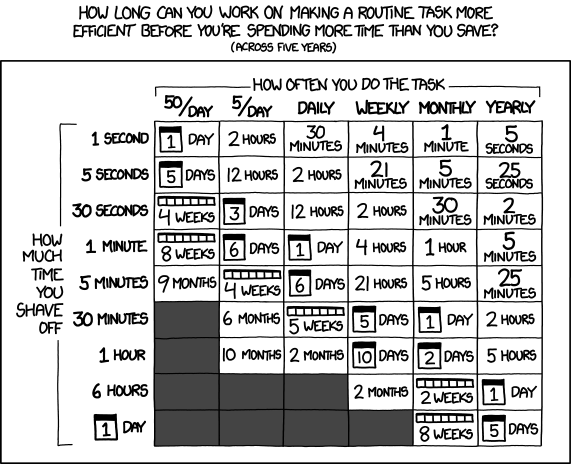
Is it worth the time?


One of the things I have been thinking about lately is how to further increase my own productivity.  Regardless of your career goals, increasing your productivity is only going to help you accomplish more (by definition) and increase your esteem as a professional.  Productivity is an interesting concept to me because it is, to a large extent, quantifiable.  How many papers did you publish this year?  How much funding did you bring in?  What kinds of committees did you serve on and what did you accomplish exactly?  All of these variables represent some measure of a person’s productivity.  Naturally, a lot of effort is spent on determining what the best measures of an individual’s productivity are – and this is a very healthy and necessary practice.  For academics and researchers, these measures usually boil down to the quality and quantity of published papers (not always in that order).
Continue reading

Posted in blogging, career, Uncategorized | 3 Comments

What we're reading: Grouper spawning, pollinator-mediated isolation, and ambivalent advice about grad school

Librarian

In the journals
Almany, G.R., Hamilton, R.J., Bode, M., Matawai, M., Potuku, T., Saenz-Agudelo, P., et al. 2013. Dispersal of grouper larvae drives local resource sharing in a coral reef fishery. Current Biology 23: 626–630. doi: 10.1016/j.cub.2013.03.006.

Using genetic parentage analysis, we measured larval dispersal from a single, managed spawning aggregation of squaretail coral grouper (Plectropomus areolatus) and determined its contribution to fisheries replenishment within five community tenure areas up to 33 km from the aggregation at Manus Island, Papua New Guinea.

Moe, A.M. & Weiblen, G.D. 2012. Pollinator-mediated reproductive isolation among dioecious fig species (Ficus, Moraceae). Evolution 66: 3710–21. doi: 10.1111/j.1558-5646.2012.01727.x.

Selection on pollinators maintaining host specificity appears to be an important mechanism of contemporary reproductive isolation among these taxa that could potentially influence their diversification.

In the news
On the mounting costs of the U.S. “sequester” for science funding.
NSF pushes back on Congressional prying into peer review.
“I’m very glad that I went to graduate school—my life would be different, and definitely worse, without it. But when I’m asked to give students advice about what they should do, I’m stumped.”

Posted in linkfest | Leave a comment